
Clay County Dissolution Of Marriage Records
Clay County dissolution of marriage records are kept by the Superior Court Clerk in Fort Gaines, Georgia. Clay is one of Georgia's smallest counties by population, located in the southwest corner of the state along the Chattahoochee River. All dissolution cases are filed at the county level with the Superior Court, and the records are open to the public under Georgia's Open Records Act. Because Clay County is small, the clerk's office serves all records functions directly, and most requests can be handled quickly by phone or mail. This page covers how to reach the clerk, what state resources can assist your search, and what Georgia law requires for a dissolution filing.
Clay County Quick Facts
Clerk of Superior Court: Fort Gaines
The Clay County Superior Court Clerk is located at 111 Brown Street, Fort Gaines, GA 39851. Mailed requests go to PO Box 550, Fort Gaines, GA 39851. The clerk's phone number is (229) 768-2631. Office hours are Monday through Friday, 8:30 a.m. to 5:00 p.m. The county does not have a dedicated clerk website, so phone and mail are the primary remote access options.
When you call or write, provide the full legal names of both parties and an approximate filing year if known. In smaller counties like Clay, the clerk's staff often has good familiarity with local cases and can sometimes locate a file quickly with minimal information. That said, providing a case number whenever possible will always speed up the search. If you need a certified copy, the clerk will tell you the current fee schedule. Fees for certified copies in Georgia are set by state law and apply uniformly across all superior courts.
Clay County is part of the Pataula Judicial Circuit, which covers several small southwest Georgia counties. The Superior Court judge handles cases from all counties in the circuit on a rotating schedule. For dissolution proceedings, you file with the Clay County clerk, and the case is assigned within the circuit. Processing times for uncontested cases are generally reasonable once the 30-day waiting period has passed, though exact timelines depend on the judge's schedule and the complexity of the case.
If you are mailing a records request to the Clay County clerk, include a brief written description of the case, the names of both parties, the approximate year, a check or money order payable to the Clerk of Superior Court, and a self-addressed stamped envelope for the return of copies. This makes the process as smooth as possible for a small county office that may have limited staff.
Georgia DPH Vital Records: 1952 to 1996
The Georgia Department of Public Health maintains a state-level verification service for dissolution records from 1952 through 1996. This service can confirm that a dissolution was recorded with the state during that period, though it does not provide a copy of the actual court file. To request a verification, contact DPH Vital Records at 1680 Phoenix Blvd Suite 100, Atlanta, GA 30349. The phone number is (404) 657-2700, and the website is dph.georgia.gov/VitalRecords. For cases before 1952 or after 1996, the Clay County Superior Court Clerk is your only source.
The screenshot below shows the DPH Vital Records page, where you can learn about the verification service and what documentation is needed to make a request for records within the 1952 to 1996 date range.
Source: Georgia DPH Vital Records

The DPH Vital Records office processes requests from across the state and can verify dissolutions filed in Clay County within the covered time period, even if you do not have the original case number.
State Online Resources for Case Searches
Even for a small county like Clay, Georgia's statewide tools can help you search for records before you contact the clerk directly. The GSCCCA eCertification portal at ecert.gsccca.org lets you request certified electronic copies of court documents from participating counties. If Clay County uploads its records to the system, you may be able to retrieve documents online. Check the portal for current county coverage.
This screenshot shows the GSCCCA eCertification portal, the state tool for requesting certified electronic copies of Georgia court records including dissolution documents.
Source: GSCCCA eCertification Portal
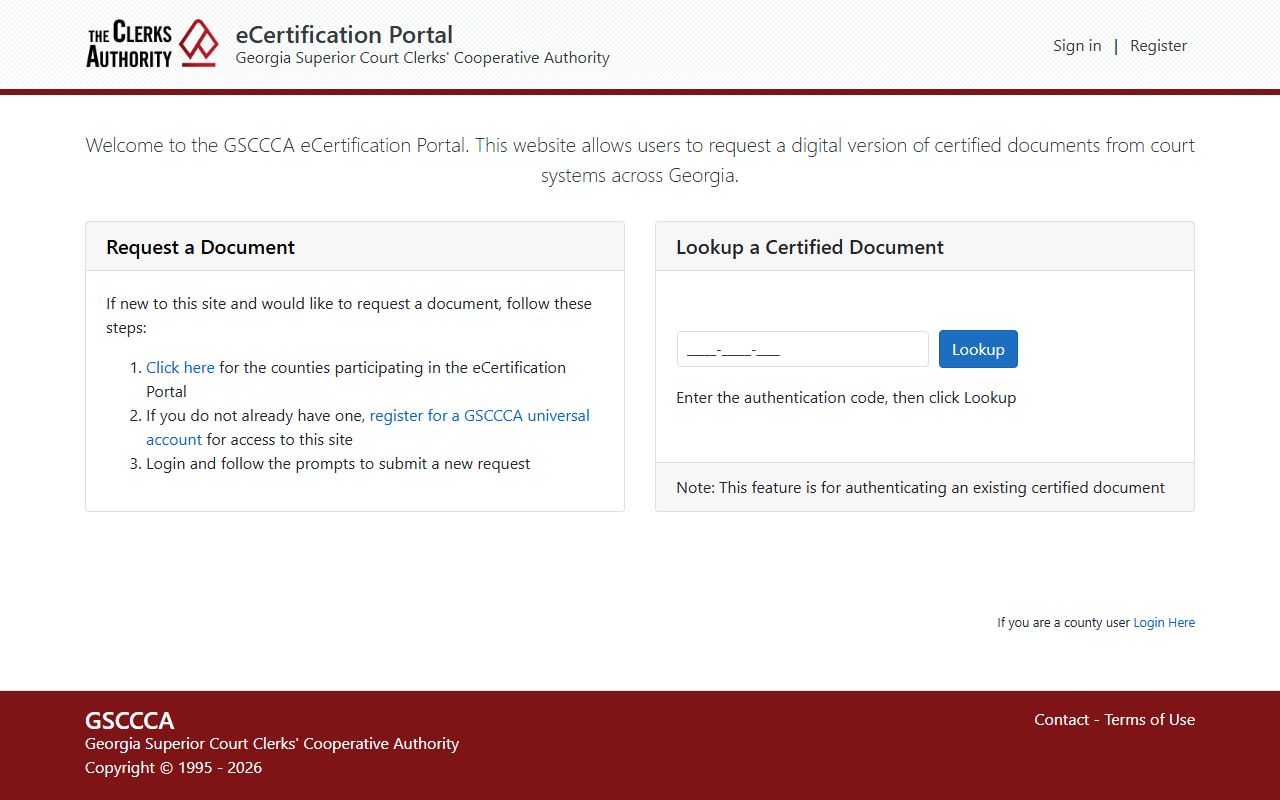
The eCert tool is especially useful when you need a legally certified copy but cannot travel to Fort Gaines. Even if Clay County does not yet participate in full online retrieval, the tool is worth checking as the state continues to expand coverage.
The Find My Clerk directory at gaclerks.org provides contact information for every county clerk in Georgia, including Clay County. The Georgia Archives at georgiaarchives.org holds a statewide dissolution index covering 1965 to 1971 and 1973 to 1999, which can help you confirm that a case exists and identify the filing county for older records.
Georgia's Filing Requirements and the 30-Day Wait
To file for dissolution of marriage in Clay County, at least one spouse must have lived in Georgia for six continuous months before the petition is filed. This residency requirement is established by Georgia Code Title 19. The case is normally filed in the county where the defendant resides. If the defendant no longer lives in Georgia, the plaintiff can file in their own county of residence, which in this case would be Clay County.
Georgia provides 13 grounds for dissolution. The no-fault ground, that the marriage is "irretrievably broken," is used in the vast majority of modern cases. It does not require either party to prove fault or wrongdoing, and it is available even if the other spouse objects. After the petition is filed and the defendant is served, there is a mandatory 30-day waiting period. If both parties have reached full agreement on property, debt, and any matters involving children, the court can enter a final decree promptly after that window closes. Disputed matters extend the timeline and may require additional steps before a judge resolves the outstanding issues.
The relevant Georgia statutes are in Title 19. You can read the specific code sections at codes.findlaw.com or through Justia's Georgia Title 19 Chapter 5. Both sources present the law in plain language that is accessible to non-attorneys.
Legal Assistance for Clay County Residents
Georgia Legal Services Program at glsp.org serves lower-income Georgians in rural areas, including Clay County. This organization provides free or reduced-cost legal help for qualifying individuals dealing with family law matters. Georgia Legal Aid at georgialegalaid.org offers online guides and self-help tools that can walk you through the dissolution process without an attorney if your case is straightforward.
For private legal representation, the Georgia Bar lawyer referral service at gabar.org or 1-800-334-6865 can connect you with a licensed family law attorney. Given Clay County's small size and rural setting, you may be referred to an attorney in Albany or another nearby city who handles cases in the Pataula Circuit. Many attorneys in southwest Georgia are familiar with the smaller county courts and can represent you efficiently even if their main office is in a larger city.
Cities in Clay County
Clay County is one of the least populous counties in Georgia. Fort Gaines, the county seat, has a population of approximately 1,000 residents. No city in Clay County meets the population threshold for a dedicated page on this site. All dissolution of marriage cases from across the county are filed through the clerk's office on Brown Street in Fort Gaines.
Nearby Counties
If a case may have been filed in a neighboring county, these pages cover the surrounding jurisdictions.