
Search Lowndes County Dissolution Of Marriage Records
Lowndes County dissolution of marriage records are filed and kept by the Superior Court Clerk at the Lowndes County Courthouse in Valdosta, Georgia. Every petition, motion, and final decree in a dissolution case becomes part of the public court record once the clerk receives it. Valdosta is the largest city in South Georgia and serves as a regional hub, so the Lowndes County Superior Court handles a considerable volume of dissolution cases each year. This page covers how to search those records, what they contain, how to file a new case, and where to get legal help in the Valdosta area.
Lowndes County Quick Facts
Superior Court Clerk - Where Dissolution Records Are Filed
The Superior Court Clerk in Lowndes County is the official keeper of all dissolution of marriage case files. The courthouse is at 327 North Ashley Street in Valdosta. The mailing address for requests is PO Box 1349, Valdosta, GA 31603. Call the clerk at (229) 333-5127 with questions. Office hours are Monday through Friday, 8:30 a.m. to 5:00 p.m. The clerk does not maintain a public case search website, so phone calls and in-person visits are the main access points.
When you visit in person, bring a valid photo ID. The clerk's staff can search by party name or case number. They can tell you what documents are in a file and quote the current copy fees. Certified copies are what most people need for legal purposes, including name changes and property transfers. Plain copies cost less if you only need to read the document. For older cases, call ahead so the file can be pulled before you arrive.
Mailed records requests should go to the PO Box above. Include both parties' names, the estimated year of filing, and a check or money order payable to the Lowndes County Superior Court Clerk. Include your return address and a phone number in case the clerk needs to reach you for clarification.
Online Access and Statewide Portals
Georgia offers statewide tools that may help you find Lowndes County dissolution records before making a trip to Valdosta. The Georgia Superior Court Clerks' Cooperative Authority, known as GSCCCA, is a major statewide records portal. Check whether your case appears there first. The GSCCCA is reachable at (404) 327-9058.
The image below shows the Find My Clerk directory from the Georgia Superior Court Clerks' Association. This is a quick way to confirm contact details for the Lowndes County clerk and to find out whether any online tools are available for that office.
Source: gaclerks.org/Clerks/FindMyClerk.aspx
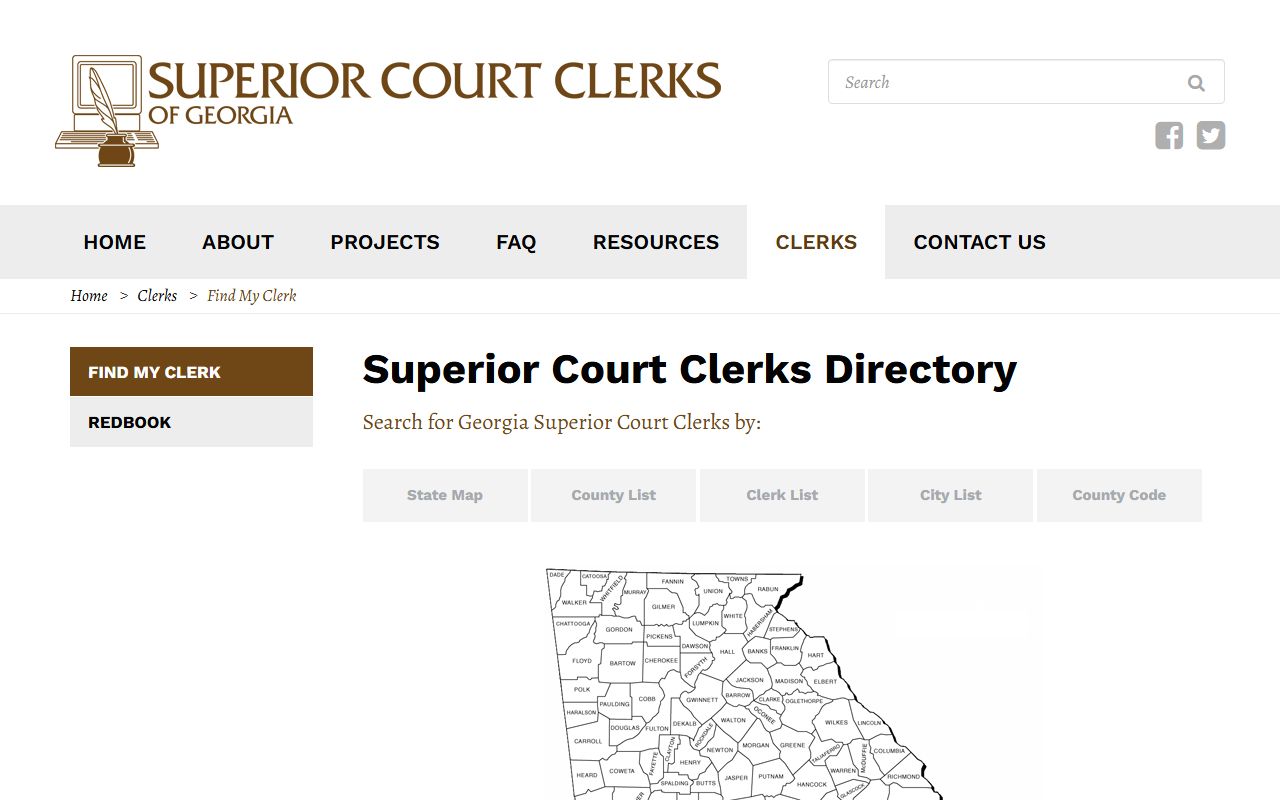
Use this directory to confirm that 327 North Ashley Street is the current courthouse location and that (229) 333-5127 is the active number before you call or visit.
The image below shows the GSCCCA portal homepage. Many Georgia counties have their dissolution case index accessible through this system, and it is worth checking Lowndes County data there before making the drive.
Source: gsccca.org
From the GSCCCA portal, you can search by name, case number, or document type across participating counties. Results may include case index data, images of filed documents, and links to request certified copies.
PeachCourt is another statewide system for e-filing and case access in Georgia. re:SearchGA is a Tyler Technologies platform that provides additional case search options for Georgia courts. Check both for Lowndes County records before contacting the clerk directly.
Filing for Dissolution in Lowndes County
To file for dissolution of marriage in Lowndes County, at least one spouse must have been a Georgia resident for six months before the petition is filed. This is a statewide rule. You file in the county where the defendant lives. If the defendant lives out of state, you may file in the county where you currently reside, which can be Lowndes County.
Georgia law provides 13 grounds for dissolution of marriage. The most common is that the marriage is irretrievably broken. This no-fault ground avoids the need to prove that either party did something wrong. It is simpler and is used in most uncontested cases. Other grounds include adultery, willful desertion for at least one year, and cruel treatment. The full statutory list is at Georgia Code Section 19-5-3.
After you file and serve the other party, a 30-day waiting period begins. The judge cannot sign the final decree until those 30 days pass. In uncontested cases where both parties agree on all terms, the case can proceed quickly after the waiting period. Contested cases take longer and may involve mediation or hearings. Lowndes County is served by the Southern Judicial Circuit of Georgia. Cases are heard at the courthouse in Valdosta.
Self-represented filers can find court forms at georgiacourts.gov. The clerk's staff can also point you to the right forms when you call or stop by. Pay your filing fee to the clerk when you submit your petition.
What Dissolution Records Contain
A dissolution of marriage case file in Lowndes County includes every document the court received from filing through final order. The petition opens the file and states what the petitioner wants. If the other party files an answer, that goes in the file too. Any temporary orders for support, custody, or property use during the case are also part of the record.
The final decree is the main document. It is the judge's written order that ends the marriage. It covers property division, debt allocation, child custody and visitation if children are involved, child support amounts, and any alimony awarded. The clerk keeps the original decree. Certified copies are available and are generally what banks, government agencies, and attorneys ask for.
Dissolution records in Lowndes County are public records. Any person can request access to them. The clerk may restrict certain details about minor children or sealed financial matters, but most of the case file is open. Bring your ID to the clerk's office and ask about the current copy fee schedule before making your request.
Historical Records and Vital Records Verification
For older Lowndes County dissolution records, the Georgia Archives maintains a statewide index covering 1965 to 1971 and 1973 to 1999. This index confirms that a dissolution occurred and identifies the county of filing. It does not hold full case documents, but it is a useful starting point. The Archives are at georgiaarchives.org.
The Georgia Department of Public Health offers a dissolution verification service covering 1952 through 1996. This is a short confirmation, not a copy of the court decree. For the full file, contact the Lowndes County clerk. The DPH website is dph.georgia.gov/VitalRecords, phone (404) 657-2700, located at 1680 Phoenix Blvd Suite 100, Atlanta, GA 30349.
Legal Help in Lowndes County
Lowndes County residents can access several legal resources. Georgia Legal Services Program serves lower-income Georgians with free legal help; visit glsp.org to find the nearest office and learn about eligibility. Georgia Legal Aid at georgialegalaid.org has online guides that walk you through dissolution forms and procedures in plain language.
For private attorneys, the Georgia Bar's lawyer referral service at gabar.org and 1-800-334-6865 can connect you with a family law attorney in Valdosta. Many Valdosta area attorneys handle dissolution cases in Lowndes County regularly and offer initial consultations at a reduced rate. Getting even one meeting with an attorney can help you avoid mistakes that are hard to fix later.
Valdosta State University's legal community may also offer clinics or student-supervised legal help programs. Contact the university directly to ask about any current offerings for local residents who need help with dissolution matters.
Cities in Lowndes County
Valdosta is the county seat and the largest city in Lowndes County. It is the only city in Lowndes County that meets the population threshold for a dedicated records page.
Other communities in Lowndes County include Dasher, Hahira, Lake Park, Remerton, and Naylor. Dissolution cases from all of these areas are filed with the Superior Court Clerk at 327 North Ashley Street in Valdosta.
Nearby Counties
These counties border Lowndes County. If you are unsure where a case was filed, check the address where the defendant lived at the time of filing.
Lanier and Thomas counties also border Lowndes County.