
Madison County Dissolution Of Marriage Records
Madison County dissolution of marriage records are kept by the Superior Court Clerk at the Madison County Courthouse in Danielsville, Georgia. Every petition, order, and final decree filed in Madison County becomes part of the public record once entered by the court. Madison County is a growing Northeast Georgia county that borders Clarke County, home of Athens, so some residents may have connections to both counties depending on where they live. This page covers how to find and request dissolution records from the Danielsville office, what the records contain, and how to file a case or get legal help.
Madison County Quick Facts
Superior Court Clerk - Office in Danielsville
The Superior Court Clerk in Madison County is the official custodian of all dissolution of marriage case files for this county. The courthouse is at 91 Albany Avenue in Danielsville. The mailing address for requests is PO Box 47, Danielsville, GA 30633. Call the clerk at (706) 795-6310. Office hours are Monday through Friday, 8:30 a.m. to 5:00 p.m. The clerk does not operate a public case search website, so phone calls and in-person visits are the main ways to access records.
When you visit, bring a valid photo ID. Staff can search by party name or by case number. They can confirm what is in a file and tell you what copies cost. Certified copies are needed for most legal uses. Plain copies are cheaper when you only need to read the document. If your request is for an older case, call ahead so the file can be pulled before you make the drive to Danielsville.
Mailed requests go to the PO Box above. Include both parties' full names, the approximate year of filing, and any case number you have. Send a check or money order payable to the Madison County Superior Court Clerk. The office will contact you if they need more details to locate the case.
Statewide Online Search Tools
Madison County does not have a public online case search portal. Georgia's statewide tools are the best online option for locating records before contacting the clerk. The Georgia Superior Court Clerks' Association directory is shown in the image below. Use it to confirm current clerk contact information and to see if any online portal links are listed for Madison County.
Source: Georgia Superior Court Clerks' Association

The directory includes current addresses, phone numbers, and any online access information for every county clerk in Georgia, including Madison County.
The image below shows the Georgia statutes page at FindLaw for Title 19 of the Georgia Code. Georgia Code Section 19-5-3 lists the grounds for dissolution of marriage and the procedural requirements that apply in Madison County just as they do across the state.
Source: codes.findlaw.com/ga/title-19-domestic-relations/ga-code-sect-19-5-3/
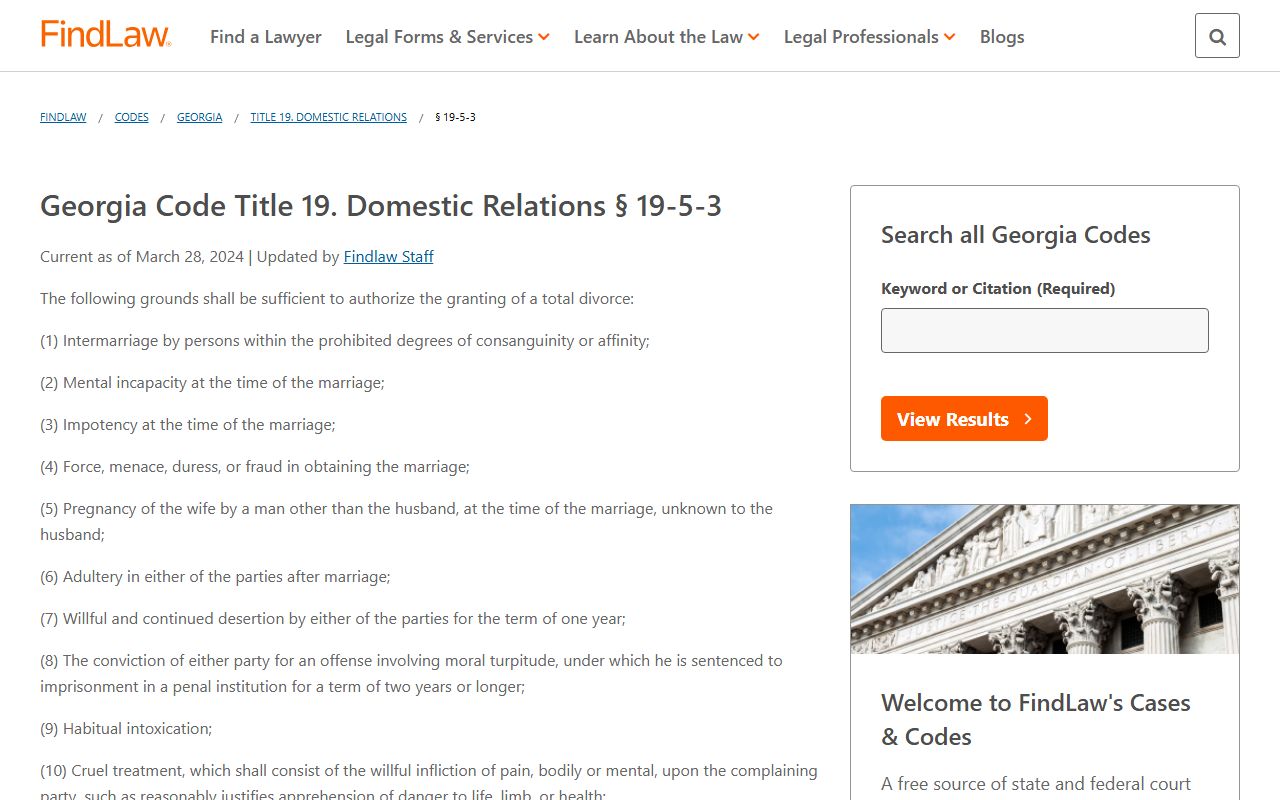
This statute page is a reliable reference for understanding what Georgia law requires in a dissolution case filed in Madison County.
The GSCCCA portal at gsccca.org and the Find My Clerk tool are also useful for locating Madison County records online. The GSCCCA may index Madison County dissolution case data, saving you a trip to Danielsville if the record appears there.
Filing for Dissolution in Madison County
Georgia law requires that at least one spouse has lived in Georgia for six months before filing a petition for dissolution of marriage. This applies in Madison County just as in every other Georgia county. The case is filed in the county where the defendant lives. If the defendant lives out of state, you may file in your county of residence, which can be Madison County.
The grounds for dissolution in Georgia are set out in Georgia Code Section 19-5-3. The most common ground is that the marriage is irretrievably broken. This no-fault ground is the simplest to use because neither party has to prove that the other did anything wrong. Other grounds include adultery, willful desertion for at least one year, and cruel treatment.
Once you file and serve the other party, a 30-day waiting period begins. The court cannot sign a final decree before those 30 days pass. Uncontested cases where both parties agree on all terms can close quickly after the wait. Contested cases with disagreements over property, children, or support take longer and may require hearings. Madison County is served by the Northern Judicial Circuit of Georgia, which also covers Elbert, Hart, Lincoln, and Oglethorpe counties. Circuit judges travel to hold sessions in Danielsville.
Georgia court forms are available at georgiacourts.gov. Bring completed forms and your filing fee to the clerk's office. Staff can confirm which forms you need for your specific situation.
What Dissolution Records Contain
A dissolution of marriage file in Madison County contains all documents from the opening of the case to its close. The petition starts the record. It names both parties, states the grounds for dissolution, and says what relief the petitioner seeks. The respondent's answer, if filed, goes into the record too. Any temporary orders entered while the case was pending are part of the file.
The final decree is the key document. It is the judge's written order ending the marriage and setting all the terms. Property division, any debt allocation, custody and visitation for children if applicable, child support amounts, and alimony if ordered all appear in the decree. The clerk keeps the original. Certified copies are available for a fee. Most banks, government agencies, and other institutions require certified copies rather than plain ones.
Dissolution records in Madison County are public records. Any person can request access. The clerk may limit access to certain details about minor children or sealed matters, but most of the case file is open. Bring your ID and ask about copy fees before you make the trip to Danielsville.
Historical Records
For older dissolution records from Madison County, the Georgia Archives maintains a statewide index for 1965 to 1971 and 1973 to 1999. This index can confirm a dissolution took place and identify the county. It does not contain full case files, but it points you to the right clerk's office. Visit georgiaarchives.org to search the index online.
The Georgia Department of Public Health offers a dissolution verification service covering 1952 through 1996. This confirms the state received notice of the dissolution during that period. For the full court file, contact the Madison County clerk. For records outside both of these windows, call the clerk and ask about how far back their records go and what format older files are in.
Legal Help in Madison County
Georgia Legal Services Program provides free legal assistance to lower-income residents of Madison County. Visit glsp.org to learn about eligibility and find the intake process. Georgia Legal Aid at georgialegalaid.org has step-by-step guides for dissolution cases, including form instructions written in plain language. Both are good places to start if you want to handle your own case.
For private attorneys, the Georgia Bar's referral service at gabar.org and 1-800-334-6865 can connect you with a family law attorney. Attorneys in Athens, which is just over the county line in Clarke County, often handle cases in Madison County. A first meeting with an attorney can help you understand your rights and avoid mistakes that are hard to correct once a decree is entered.
Cities in Madison County
Danielsville is the county seat of Madison County with a population of around 490. No city in Madison County meets the population threshold for a dedicated records page. Dissolution of marriage cases from every part of Madison County are filed with the Superior Court Clerk in Danielsville.
Nearby Counties
These counties border or are near Madison County. If a case may have been filed in a neighboring jurisdiction, each has its own Superior Court Clerk and dissolution records.