
Meriwether County Dissolution of Marriage Records
Dissolution of marriage records in Meriwether County are held by the Superior Court Clerk in Greenville and are open to the public under Georgia's open records laws. If you need a certified copy of a final decree, want to check whether a case was filed, or are looking up older records for a legal or personal matter, the clerk's office in Greenville is the right place to start. This page walks through how to search, what statewide tools to try first, how the filing process works, and where to find legal help in this part of west-central Georgia.
Meriwether County Quick Facts
Meriwether County Superior Court Clerk
The Superior Court Clerk in Greenville holds all dissolution of marriage records filed in Meriwether County. The clerk's office is inside the Meriwether County Courthouse at 100 North Court Square. Staff can assist with case searches, status checks, and certified copy requests during regular business hours. Mail requests go to the PO Box, not the physical address, so use the correct address when mailing documents or fees.
| Office | Meriwether County Superior Court Clerk |
|---|---|
| Address | 100 North Court Square, Greenville, GA 30222 |
| Mailing Address | PO Box 160, Greenville, GA 30222 |
| Phone | (706) 672-4416 |
| Hours | Monday through Friday, 8:30 AM to 5:00 PM |
| Website | Find My Clerk Directory |
Before you call or visit, gather the full names of both parties and the approximate year the case was filed. That information lets staff narrow the search quickly, especially for older files that may not yet be in a digital index.
How to Search Meriwether County Dissolution of Marriage Records
Meriwether County does not have its own public case search website. Most searches start with a direct phone call or visit to the courthouse in Greenville. Before making the trip, it is worth checking a few statewide tools that may have what you need.
The Georgia Superior Court Clerks' Cooperative Authority (GSCCCA) operates a statewide index of civil filings and recorded documents. Coverage varies by county and by year, but the system is a solid first check. If the case appears in the GSCCCA index, you can request a certified copy through the eCertification portal at ecert.gsccca.org without having to visit Greenville in person.
The state's courts portal at georgiacourts.gov links to court resources and case management tools across Georgia. It does not hold Meriwether County records directly, but it can help you figure out where a case was filed if you are unsure. PeachCourt, the state's eFiling platform, supports case status lookups for courts that participate. If your case was filed more recently, it may be searchable there.
Older cases that predate online systems are best accessed by visiting or calling the Greenville courthouse directly. Bring a photo ID and expect to pay a fee for any certified copies. Staff can tell you if certain records are stored off site or exist only in paper format.
The Superior Court Clerks' Association of Georgia directory lists current contact details for all 159 county clerk offices, so you can confirm you have the right number and address before you reach out.
The state vital records request page shown below is part of the DPH and georgia.gov system for ordering state-level vital records, which includes limited dissolution verification for cases from 1952 to 1996.
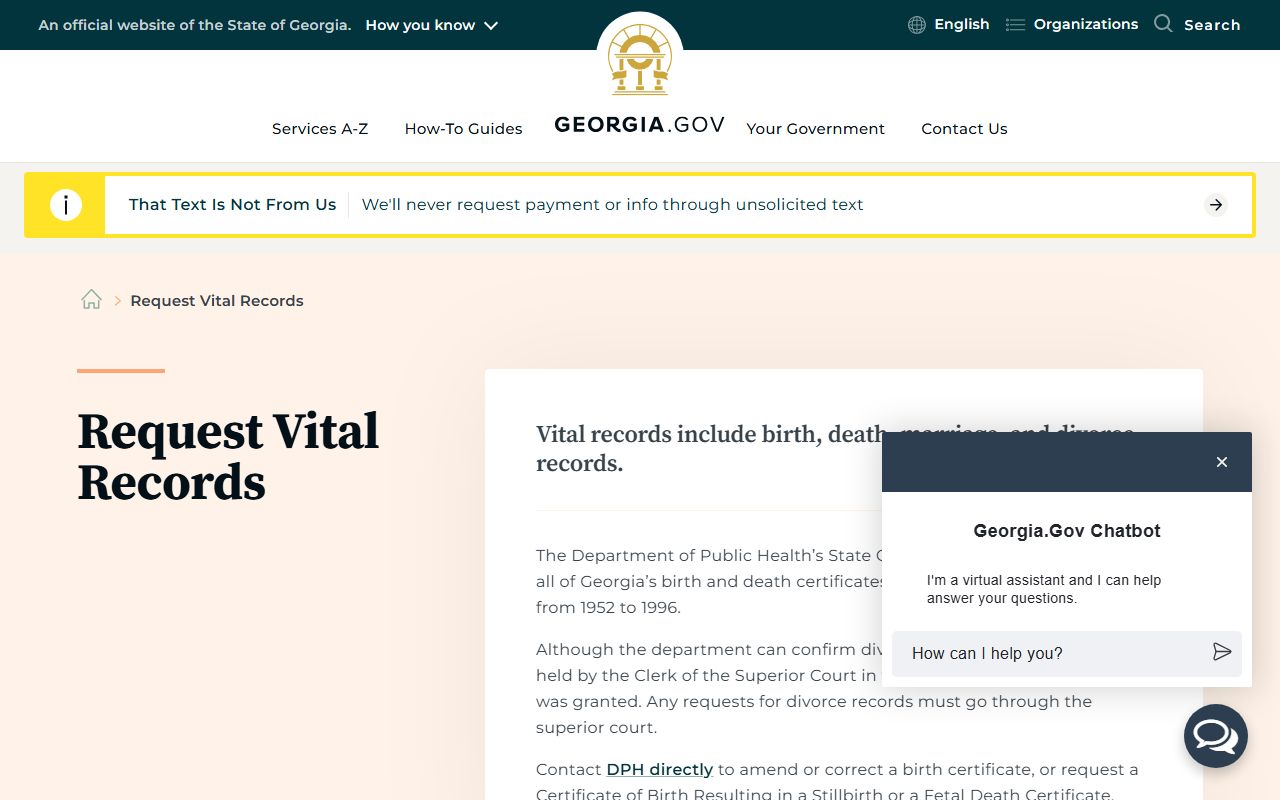
For records outside that window, or when you need the actual court documents rather than a state verification, the Superior Court Clerk's office in Greenville is the right contact.
Dissolution of Marriage Process in Meriwether County
To file for dissolution of marriage in Meriwether County, at least one spouse must have been a Georgia resident for six months or more before the petition is submitted. That rule comes from O.C.G.A. § 19-5-2. If neither party meets the residency requirement, the Meriwether County Superior Court cannot take the case.
Georgia recognizes 13 legal grounds for dissolution of marriage under O.C.G.A. § 19-5-3. The most widely used is the no-fault ground: that the marriage is irretrievably broken. This ground does not require either party to show fault or misconduct. The other 12 grounds are fault-based and are rarely invoked in practice. For the majority of uncontested cases filed in Meriwether County, the no-fault ground is the standard choice.
Once the petition is filed and served on the other party, Georgia requires a 30-day waiting period before a final hearing can be scheduled. Even if both parties are in full agreement, the court cannot issue the final decree before that period ends. Contested cases can take significantly longer. Disputes over property, custody arrangements, or support terms can extend a case by many months, depending on the court's schedule and what needs to be resolved.
The typical sequence of steps for filing in Meriwether County is:
- File the petition and required paperwork at the Superior Court Clerk's office
- Pay the filing fee when you submit the documents
- Have the other spouse served through the sheriff or a process server
- Wait the mandatory 30 days from the date service is completed
- Attend the final hearing for the judge to sign the decree
Ask the clerk's office which forms Meriwether County requires and whether any local rules apply that go beyond the standard state requirements.
What Dissolution of Marriage Records Contain
The case files held by the Meriwether County Superior Court Clerk cover the full range of documents filed during a dissolution proceeding. Simple uncontested cases are often just a few pages long. Contested matters can involve dozens of motions, exhibits, and court orders.
A typical dissolution of marriage case file may include:
- The original petition for dissolution of marriage
- Proof of service on the respondent
- Any response or counterclaim filed by the other spouse
- Settlement agreements or consent orders covering property and support
- Temporary orders entered while the case was pending
- The final decree of dissolution of marriage
- Post-decree orders modifying child custody or support amounts
The final decree is the most commonly needed document. Employers, banks, courts in other states, and government agencies often ask for a certified copy when you need to change a name or update records after a dissolution. The clerk can certify any individual document in the file, not just the final decree. All court records are public under the Georgia Open Records Act, though the court may have restricted access to sealed pleadings or records involving minor children.
State Divorce Verification Through DPH Vital Records
Georgia's Department of Public Health (DPH) Vital Records office maintains a state-level divorce verification record set, but its scope is narrow. Understanding what they hold before you contact them will save time.
DPH can only verify that a divorce occurred in Georgia for cases filed between 1952 and 1996. They do not hold court files, certified decrees, or case documents. What DPH provides is a verification letter confirming the event. If you need actual court documents, or if the case falls outside the 1952 to 1996 range, you must contact the Superior Court Clerk in the county where the case was filed. For Meriwether County cases, that is the clerk's office in Greenville.
DPH Vital Records is at 1680 Phoenix Blvd Suite 100, Atlanta, GA 30349. Phone is (404) 657-2700, Monday through Friday from 8 AM to 5 PM. A search fee applies and Form 3917 is required. See dph.georgia.gov/VitalRecords for current details.
The re:SearchGA portal shown below is the Tyler Technologies case lookup system used by several Georgia counties and courts. It can be useful for finding case numbers and basic filing information for more recently filed matters.
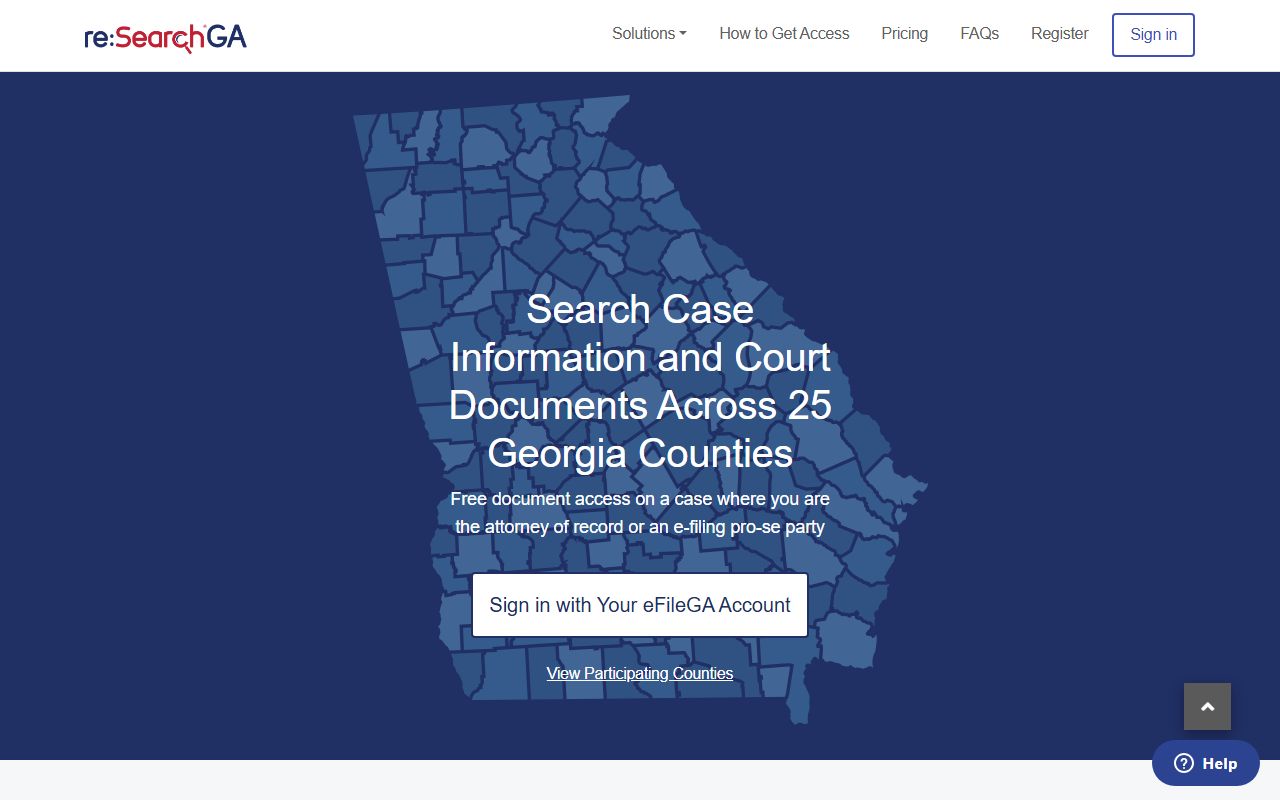
Not every Georgia county participates in re:SearchGA, so results may vary. When the portal does not return a result, contacting the clerk directly is always the reliable fallback.
Legal Help for Dissolution of Marriage in Meriwether County
If you need legal guidance for a dissolution of marriage case in Meriwether County, several organizations and resources can help. Getting the right advice early on is almost always worth it.
Legal Services Georgia provides free civil legal assistance to low-income residents in Georgia, including Meriwether County. They handle family law cases including dissolution of marriage, custody, and support. Contact their office to check whether you qualify and to get connected with someone who can help with your specific situation.
Georgia Legal Aid offers a comprehensive set of self-help guides online. The materials are written in plain language and cover the full dissolution process, from how to file the initial petition to what happens at the final hearing. This resource is especially useful if you are handling an uncontested case on your own and need step-by-step guidance.
The State Bar of Georgia has a lawyer referral line at 1-800-334-6865. Attorneys in the Greenville area know local court practices and can advise you on anything specific to Meriwether County proceedings. Even a single consultation can answer questions that are hard to work out from statutes alone.
The Georgia Archives in Morrow holds a statewide divorce index on microfiche covering cases from 1965 to 1971 and 1973 to 1999. If you are searching for an older Meriwether County case and clerk records are incomplete or hard to access, the Archives index may give you the confirmation you need to locate the right file.
Cities in Meriwether County
Greenville is the county seat of Meriwether County and the city where dissolution of marriage cases are filed. No cities in Meriwether County currently exceed the population threshold for a dedicated records page on this site. Greenville residents and all others in the county file and request dissolution records at the Superior Court Clerk's office at 100 North Court Square. Nearby qualifying city La Grange is in Troup County, just to the southwest, and has its own records page.
Nearby Counties
Meriwether County borders several counties in west-central Georgia, each with a Superior Court Clerk managing dissolution of marriage records for their own jurisdiction.